
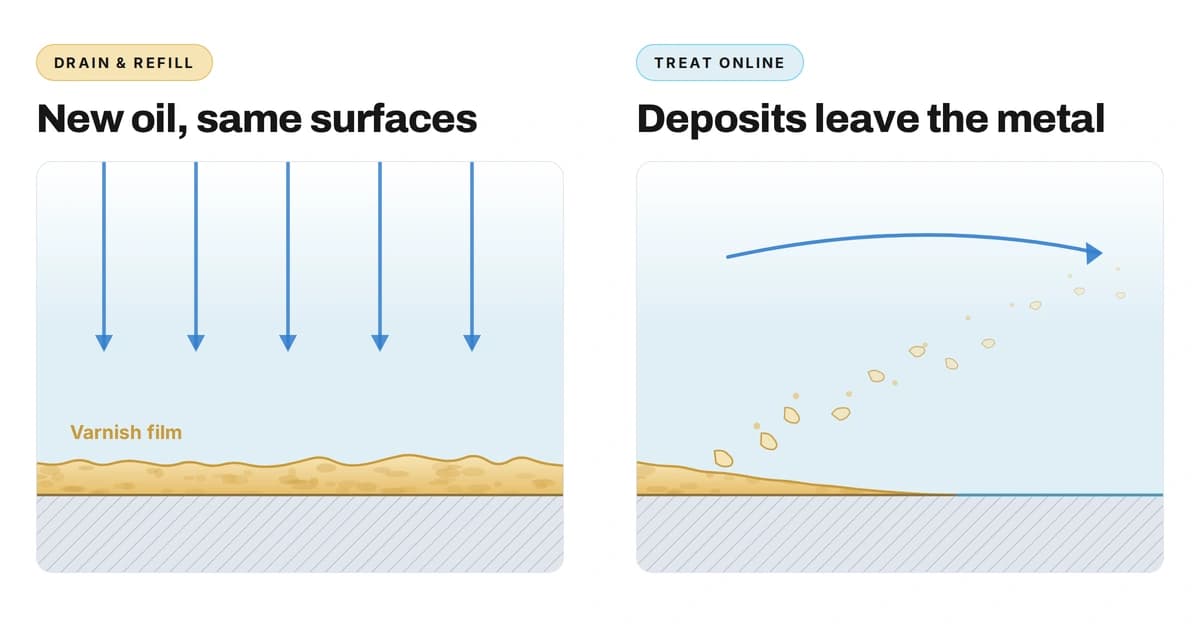
“We'll just change the oil.” It is a familiar answer when a turbine bearing temperature starts to creep up, a servo valve responds slowly, or filters need attention more often. The oil has been in service for years, so a flush and fresh charge feel like the cleanest way to reset the problem.
That may replace the oil. It does not necessarily remove the problem. Turbine varnish can remain on bearings, valves, cooler surfaces, pipework and quiet areas of the system after the reservoir is drained. When fresh oil enters that same system, it can pick up degradation products from the surfaces you could not reach. The plant pays for new oil and an outage—then watches the symptoms return.
The business problem
An oil change can become an expensive reset, not a lasting fix.
A condition-led response asks three questions first: where are the deposits, what condition is the oil chemistry in, and which removal or treatment method fits this system? That is how you avoid spending money on the wrong intervention.
The varnish problem you may not know you have
Varnish begins with lubricant degradation. As the oil is stressed and its antioxidant protection is consumed, degradation products build in the fluid. Some remain dissolved; others leave the oil and form soft, sticky deposits on internal surfaces.
That distinction matters. A standard particle filter is designed for hard contamination, not every dissolved or soft degradation product. Routine oil properties can also look acceptable while deposits are already affecting the machine. The first visible clue may be operational rather than cosmetic.
Five warning signs worth connecting
- Bearing temperatures are rising without a clear mechanical explanation.
- Servo or control valves are slow, erratic, or beginning to stick.
- Oil coolers are losing efficiency or filters need attention more often.
- The oil looks acceptable in routine tests, but operational symptoms keep returning.
- A recent oil change delivered only temporary relief.
None of these symptoms proves varnish by itself. Bearings run hot and valves stick for other reasons. But when several appear together—especially with an aging turbine or compressor oil charge—varnish belongs on the diagnostic shortlist.
Where the cost of the default response hides
The purchase order for replacement oil is only the visible line. The real cost can span the shutdown, labour, flushing, filtration, disposal, recommissioning and the production risk around the work. If the system itself remains contaminated, the plant can pay a second time when the new charge begins to show the same problem.
The outage window
Draining, flushing, refilling and recommissioning consume planned downtime—and an urgent varnish response may not wait for the plan.
The new oil charge
A large turbine or compressor reservoir ties up lubricant, handling and disposal cost before the underlying deposit problem is solved.
The repeat event
Deposits left on internal surfaces can load the fresh oil, shortening the value of the intervention and bringing symptoms back.
The production risk
Sticky control components, rising bearing temperatures and poor heat transfer can turn an oil problem into an availability problem.
For power generation, refining, fertilizer, petrochemical and industrial-gas operators, the hardest cost is often opportunity: the unit is unavailable when production needs it, or an emerging control problem forces maintenance into a window the plant did not choose.
Why fresh oil can inherit an old varnish problem
Draining a reservoir removes the oil that can flow out. It does not automatically clean varnish bonded to system surfaces. A conventional flush can leave deposits in low-flow regions, bearing housings, valves, coolers and pipework. Fresh turbine oil then meets a system that is still carrying years of degradation products.
The new oil can begin dissolving material from those surfaces. Instead of starting with a clean system and a clean charge, the plant uses the replacement oil as an unintended cleaner. That is why the right question is not simply, “Should we change the oil?” It is, “What condition must the system be in before fresh oil goes in—and does the oil need replacing at all?”
If the deposit source remains inside the system, replacing the reservoir charge treats the inventory, not the cause.
A documented refinery outcome: MPC 27 to 7 in one month
A major oil refinery in Spain faced this decision on its gas turbines. Oil analysis showed very low antioxidant levels and an MPC varnish-potential result of 27. The refinery was facing a shutdown for a system flush and full oil replacement.
The selected response was an oil-specific treatment program using Fluitec DECON AO at a 3% treat rate. The objective was to address deposits while restoring the depleted antioxidant balance, allowing the units to stay in operation.
27 → 7
MPC within one month
$258K
documented cost avoided
No flush
or full oil replacement
The case study reports that MPC fell from 27 to 7 within one month, antioxidant levels were restored, the system remained varnish-free, and there were no unexpected shutdowns. It records $258,000 in savings from avoiding the oil flush, replacement and associated downtime.
This is a documented result from one refinery, not a typical saving or a promise for another plant. Treat rate, compatibility, removal method and outcome depend on the oil formulation, system condition, operating duty and evidence collected before treatment.
What a lasting varnish response looks like
The solution is not “add a chemical” or “install a filter” by default. It is a closed reliability loop that connects the symptom, oil chemistry and system condition before selecting the intervention.
- Confirm the problem. Combine operating symptoms with an appropriate oil-analysis slate. Membrane Patch Colorimetry (MPC) is useful for trending varnish potential in applicable turbine oils; antioxidant trending helps show whether the oil's protective chemistry is being depleted.
- Find the exposure. Review temperature history, valve or bearing symptoms, oil age, filtration, contamination events and previous oil changes. One sample is a snapshot, so trend evidence carries more weight than an isolated number.
- Choose the mechanism. Depending on the system, the response may involve removing soluble and insoluble degradation products, cleaning deposited material, restoring compatible antioxidant protection, or preparing the system properly for a planned oil change. Sometimes more than one mechanism is required.
- Verify the result. Trend the oil and the machine after the intervention. A lower test result matters most when temperatures, valve behaviour, filter performance and oil health remain stable too.
NATCOM's Oil Care Technologies bring monitoring, contamination control and oil treatment into that loop. The objective is not to save every oil charge. It is to avoid the wrong maintenance action and protect the availability of the asset.
Before you approve the next flush
Put the symptoms, oil history, MPC/antioxidant trend and previous interventions on one page. Then ask whether the proposed work removes deposits from the system, stabilizes the oil, and includes a way to prove the result.
Frequently asked questions
What is turbine oil varnish?
Turbine oil varnish is a sticky deposit formed from lubricant degradation products. It can collect on bearings, valves, coolers, filters and other internal surfaces, affecting how the system transfers heat and how closely fitted components move.
Will changing turbine oil remove varnish?
Not necessarily. An oil change replaces the fluid in the reservoir, but deposits can remain on internal system surfaces. Those deposits can interact with the fresh charge, so system cleanliness and oil chemistry must be considered together.
What are common warning signs of turbine varnish?
Common warning signs include sticky or erratic valves, rising bearing or oil temperatures, poorer cooler performance, frequent filter problems, vibration symptoms, trips or fail-to-start events. These symptoms are not unique to varnish, so diagnosis should combine operating evidence with appropriate oil analysis.
How is turbine varnish risk assessed?
A varnish assessment can combine Membrane Patch Colorimetry (MPC), antioxidant trending such as RULER, oil chemistry, operating history and inspection evidence. One result is a snapshot; the trend and system context support the decision.
Can turbine varnish be treated while the unit operates?
Some deposit-removal, filtration and oil-treatment approaches can be applied online, depending on the oil, system, contamination state and compatibility review. Other systems still require a planned oil change or outage. The method should follow diagnosis, not precede it.
The maintenance decision is bigger than the oil
Varnish is easy to treat as a consumables problem because it appears in the lubricant system. In reality, it is an asset-availability problem with an oil signal. The plant that recognises it early can choose its intervention. The plant that waits for the valve, bearing or trip to make the decision has already surrendered that choice.
If the same temperatures, valve behaviour or oil alarms keep returning after a change, do not assume the replacement oil failed. Ask what the system kept. When did your last oil change actually fix the varnish—or did the temperatures creep back up a few weeks later?