
A sluggish steam-turbine governor valve can look like a controls or valve-maintenance problem. In a fertilizer plant, it can be much more expensive than that. The governor valve regulates steam into the turbine. If its response becomes slow or erratic, the turbine can move away from its control target and trip the compressor train it drives.
That is what Fluitec documents at a chemical fertilizer plant in Egypt. Sticky varnish was found on the valve stem and spool. Control deviation exceeded the plant's 10% trip threshold, causing automatic shutdowns. Every event stopped nitric acid production for an estimated 6 to 8 hours.
The business problem
The plant was not fighting an oil-colour problem. It was losing a production train.
The useful question was not simply how to free the valve. It was why the valve had become sticky, what the oil system was carrying, and how the team could prove that the cause had been controlled.
Why one governor valve threatened nitric acid production
The plant's steam turbine drives a train made up of an air compressor, a nitric oxide compressor, and an expander. According to the case study, these units run continuously at full capacity at the centre of the nitric acid process. A turbine trip therefore interrupts both nitric acid production and the fertilizer output that depends on it.
Control deviation above 10%
The governor valve responded erratically enough for turbine control to move beyond the plant's trip threshold.
Multiple automatic trips
The source records several events before treatment. The problem had moved beyond a maintenance warning.
6 to 8 hours lost per trip
Each unplanned shutdown stopped nitric acid production while the plant recovered and restarted the train.
Downstream fertilizer output exposed
The turbine drives a compressor train at the centre of the plant's continuous nitric acid process.
The source reports multiple trips before the intervention. By that point, the valve symptom was already an availability problem. The cost sat in lost production, restart work, and the risk of the next event arriving before the plant had chosen a maintenance window.
The evidence pointed beyond the valve
Maintenance personnel physically inspected the governor valve and found sticky varnish on the stem and spool. Oil analysis then recorded a Membrane Patch Colorimetry result of 30.3. Membrane Patch Colorimetry, usually shortened to MPC, measures the colour of oil-degradation material captured on a membrane. The result is reported as a Delta E value.
In the scale used by this case study, a result above 25 was classed as high risk. The inspection and oil result supported the same diagnosis: the valve was not only suffering from a local movement problem. The lubrication system was carrying material capable of forming deposits.
Evidence worth connecting
- Governor-valve response becomes slow or erratic under familiar operating conditions.
- Inspection finds a sticky amber or brown film on the valve stem, spool, or nearby oil-wetted surfaces.
- Oil analysis shows rising varnish potential rather than only hard-particle contamination.
- Trip records connect the valve response to speed or process-control deviation.
- The same symptom returns after valve work because the wider oil system has not been addressed.
An MPC result is not a particle count, a valve-position reading, or a full judgment on oil health. It is one piece of evidence. In this case, it mattered because it agreed with the deposit found on the valve and the operating behaviour recorded before the trips.
A sticking valve is the symptom. Sticky varnish on the stem and spool is evidence about the system.
Why valve work alone may not stop the repeat event
Cleaning, repairing, or replacing a governor valve may be necessary when it cannot respond correctly. But the replacement part returns to the same lube-oil system. If the oil still carries degradation products and deposits remain elsewhere, restoring the valve does not remove the condition that made it sticky.
An oil change can have the same gap. It replaces the reservoir charge but may leave deposits on internal surfaces. Our earlier article explains why fresh turbine oil can inherit an old varnish problem. The maintenance decision needs to cover the valve, the oil, and the system surfaces together.
What the Egyptian plant did
After the valve inspection and oil result identified varnish, NATCOM recommended Fluitec DECON™ for this system. The case study says two drums were added directly to the lube-oil reservoir while the compressor train remained in service. It describes DECON™ as mobilising deposits from metal surfaces into the oil, where the system's filtration could capture them.
For this project, Fluitec reports no shutdown, flush, oil change, or additional hardware. The document does not give the drum volume, reservoir volume, oil grade, treatment percentage, filtration details, or equipment manufacturer. "Two drums" is therefore a record of this job, not a dose to copy on another turbine.
The measured result and the machine result
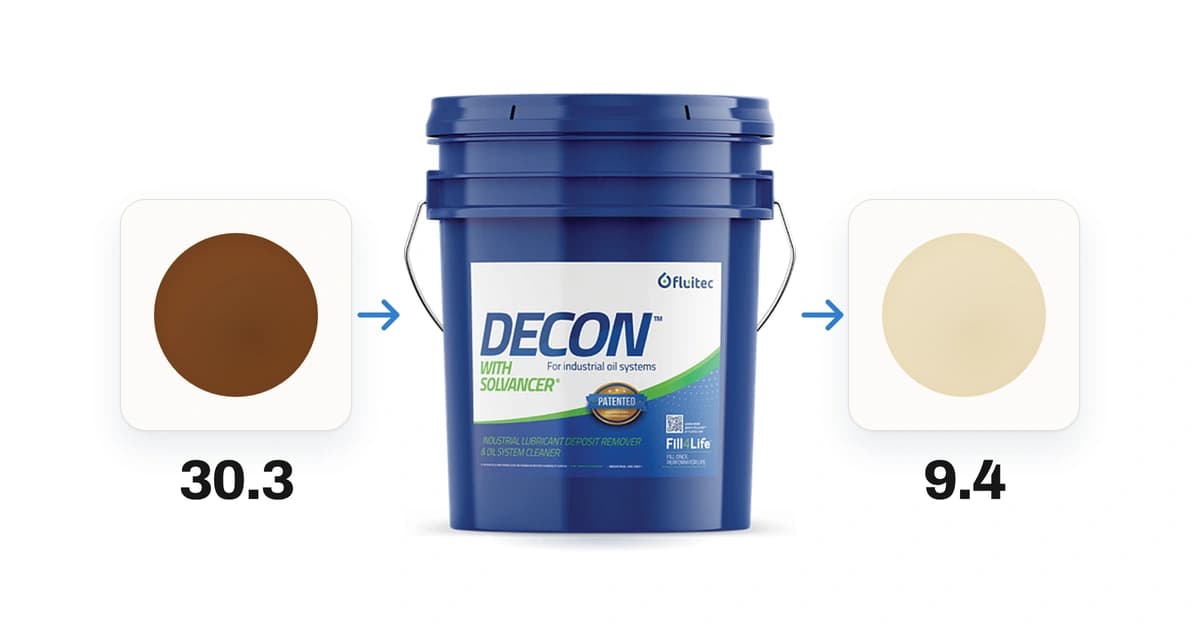
30.3 → 9.4
MPC before and after treatment
69%
reported MPC reduction
<10%
control deviation after treatment
Zero
varnish-related trips reported after treatment
MPC fell from 30.3 to 9.4, a 69% reduction. The case study places 9.4 below its stated low-risk threshold of 15. It also reports improved governor-valve response, control deviation remaining below the 10% trip threshold, and no varnish-related trips after treatment.
The follow-up period is not disclosed, so the no-trip result should be read exactly as reported, not as a permanent guarantee. This is one documented plant outcome. It does not establish a typical treatment time, dose, or result for another turbine.
The $280,000 result is an estimate, not a meter reading
Fluitec estimates that each unplanned shutdown cost the plant approximately USD 85,000 to USD 120,000, based on 6 to 8 hours of lost production and restart labour. The case then models three avoided events at about USD 100,000 each. That produces more than USD 300,000 in avoided losses, more than USD 280,000 in net benefit, and an estimated return above 13:1 for the first treatment cycle.
Those figures are useful for understanding the scale of the decision, but they are vendor estimates. The document does not provide the treatment cost, production-value calculation, or observation period needed to audit them. A plant considering similar work should build its own case from its trip history, lost production, restart cost, and proposed treatment scope.
How to investigate a sticky governor valve without guessing
- Confirm what moved and when. Review valve-position response, actuator behaviour, control deviation, alarms, and trip records. Separate a control signal problem from slow physical movement.
- Inspect the component. When safe access is available, look for sticky deposits, wear, scoring, contamination, or mechanical restriction on the stem, spool, and related oil-wetted parts.
- Build an oil baseline. Choose tests with the oil laboratory and equipment guidance. MPC can help trend varnish potential in applicable turbine oils, but the plan may also need oil chemistry, contamination, water, and remaining-antioxidant evidence.
- Find why the deposits formed. Review oil age, temperature, filtration, contamination events, make-up history, and previous interventions. Removing deposits without correcting the cause can leave the plant exposed to a repeat.
- Select and qualify the response. The answer may include component work, physical cleaning, filtration, deposit treatment, an oil change, or a combination. Check oil compatibility, system condition, and equipment-manufacturer requirements before applying a treatment.
- Verify the oil and the machine. Repeat the relevant oil tests and trend valve response, control deviation, filter behaviour, and trip history. A lower MPC result matters most when the equipment result holds too.
NATCOM's Oil Care Technologies connect the testing, contamination control, and deposit-treatment options to that decision. The oil analysis service can help define the evidence needed before the plant chooses an intervention.
Before the next governor-valve intervention
Put the valve-response trend, trip sequence, inspection findings, oil results, filtration history, and previous maintenance on one page. Then ask whether the proposed work addresses the component and the condition carried by the oil system.
Source note
Case facts and results come from Fluitec, "Chemical Fertilizer Plant in Egypt Eliminates Governor Valve Sticking and Turbine Trips with DECON™," document 26-0617-03, 2026. The customer remains anonymous. Financial figures are reproduced as Fluitec estimates.
Frequently asked questions
What can make a steam-turbine governor valve stick?
Possible causes include varnish or other deposits on the stem and spool, mechanical wear, actuator problems, misalignment, contamination, and control-system faults. Inspection, valve-response data, trip records, and suitable oil analysis are needed to separate an oil-system problem from a mechanical or controls problem.
Can turbine-oil varnish cause a unit trip?
Yes. Deposits can interfere with closely fitted oil-wetted control parts. In this Egyptian fertilizer case, sticky varnish was found on the governor-valve stem and spool, control deviation exceeded the 10% trip threshold, and the turbine tripped automatically. That single case does not mean varnish causes every turbine trip.
What does an MPC result of 30.3 mean?
Membrane Patch Colorimetry, or MPC, measures the colour of oil-degradation material collected on a membrane and reports the difference as a Delta E value. This case classified 30.3 as high risk because it was above 25. Risk bands should be checked against the oil, laboratory method, equipment guidance, and trend rather than used as universal trip limits.
Does a lower MPC result prove that the governor valve is clean?
No. A lower MPC result shows that the oil's measured varnish potential has changed. Valve response, inspection evidence, filter condition, oil health, and trip history should also improve and remain stable. MPC is not a substitute for mechanical inspection or a complete oil-analysis programme.
Can DECON™ be added while the turbine remains in service?
It was added while this compressor train remained in service, with no shutdown, flush, oil change, or extra hardware reported for the project. That is a documented single-system outcome, not a standard recipe. The oil formulation, reservoir volume, contamination, filtration, equipment condition, compatibility, and equipment-manufacturer requirements must be reviewed first.
The trip is the late warning
By the time a sticky governor valve trips a steam-turbine compressor train, the plant is no longer dealing with an abstract oil-analysis number. It is dealing with lost production. The opportunity is to connect slow valve response, physical deposits, and the oil trend before protection logic makes the maintenance decision on the plant's behalf.
This Egyptian case is useful because it closes that loop. The team saw the symptom on the machine, found the deposit on the component, measured the problem in the oil, treated the system, and then checked both the MPC result and the governor-valve behaviour.