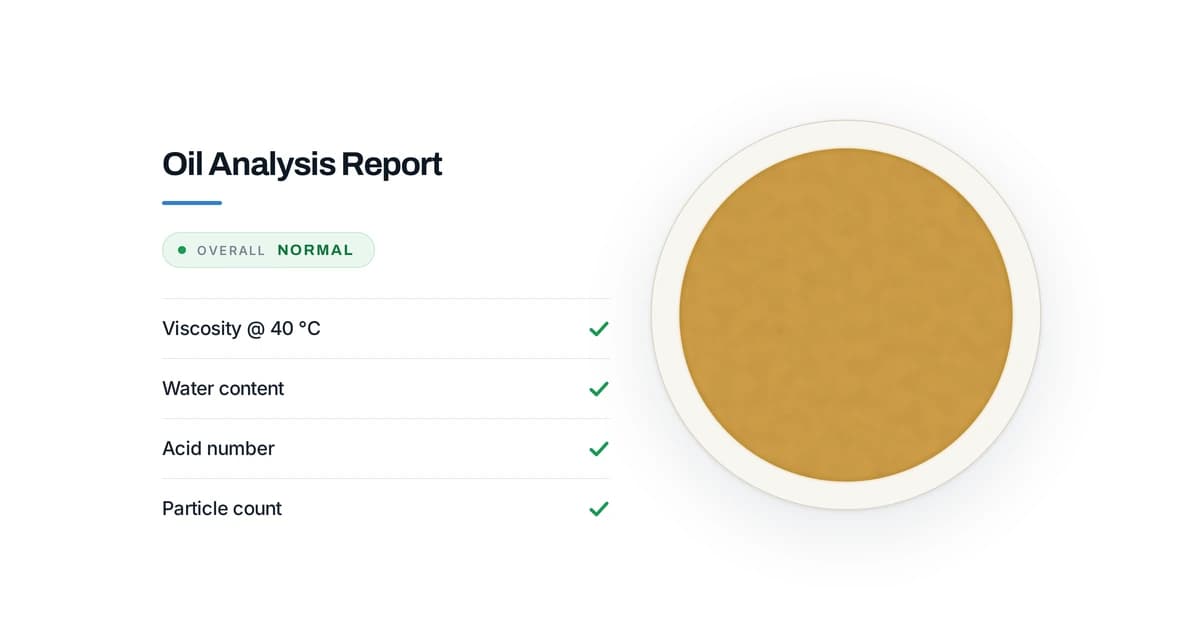
The turbine-oil report arrives with viscosity in range, no serious water warning, and a particle count that looks acceptable. The summary says "normal." Yet a bearing temperature is creeping up, a control valve is responding slowly, or filters need attention more often.
That is not a contradiction. It may be a gap between the condition the plant is worried about and the tests the laboratory ran. A result can only answer the question its method was designed to measure. If the report did not assess varnish-related insoluble material or remaining antioxidants, it did not rule out either condition.
The decision rule
A green report is not a diagnosis until you know what each test measured.
Read the report as a set of separate questions. Then connect those answers to the oil trend, the machine's behaviour, and what inspection found before you clear the oil or approve an intervention.
What a routine oil report can answer, and what it cannot
There is no useless test in the list below. The problem begins when a useful result is stretched into a conclusion it cannot support. A normal water result does not clear antioxidant health. A particle count does not identify every particle's chemistry. An acid-number result does not describe deposits already attached to system surfaces.
Viscosity
Helps answer
Has the oil become thicker or thinner than its reference range?
Does not tell you
Whether varnish-forming degradation products are collecting in the oil or on the system.
Water
Helps answer
Is moisture contamination present at the level measured by the selected method?
Does not tell you
How much antioxidant protection remains or whether insoluble colour bodies are building.
Acid number
Helps answer
How has the oil's measured acidity changed against its baseline?
Does not tell you
The full condition of the oil. Varnish-related changes can develop before this result forces action.
Particle count
Helps answer
How many particles fall into the measured size bands?
Does not tell you
The chemical identity of those particles, the condition of the antioxidants, or deposits already on metal.
A green mark beside the tests that were run is not evidence that an unmeasured condition is healthy.
The MPC test asks whether insoluble material is building
Membrane Patch Colorimetry, usually shortened to MPC, is a turbine-oil varnish test covered by ASTM D7843. The method extracts insoluble contaminants from an in-service turbine-oil sample onto a membrane. A spectrophotometer measures how far the patch colour differs from a reference and reports a Delta E value.
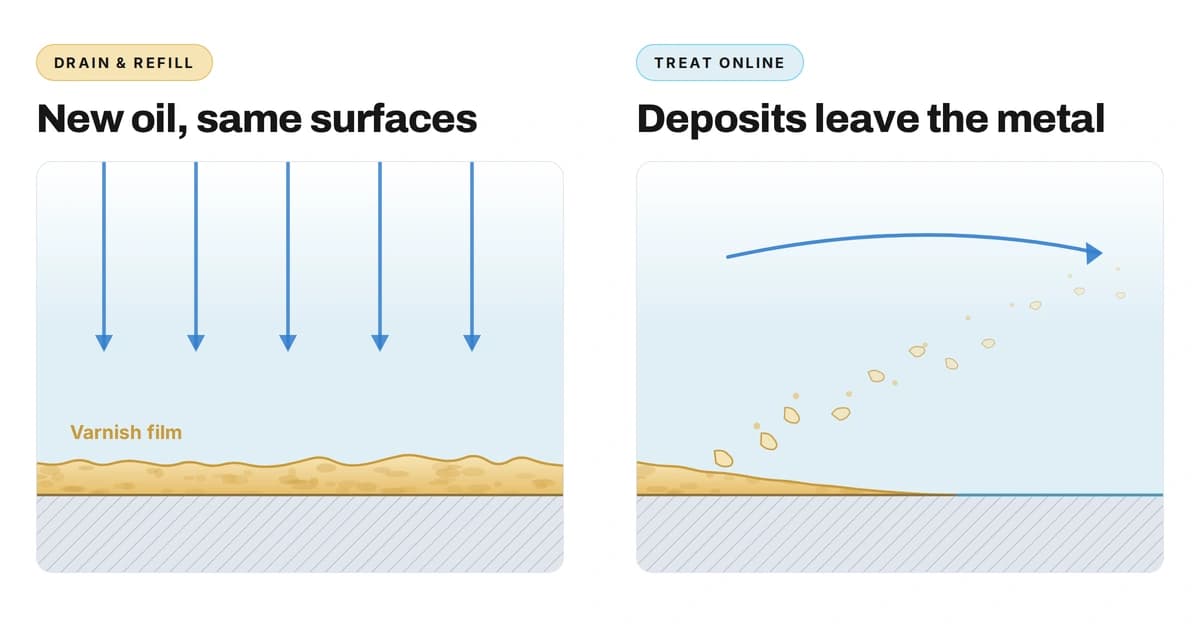
"Insoluble" means the material is no longer dissolved in the oil sample. That matters because lubricant degradation products can move out of the oil and collect on bearings, valves, coolers, filters, and other oil-wetted surfaces. MPC gives the reliability team evidence about the oil's tendency to carry deposit-forming material.
What MPC adds
A repeatable colour result that can be trended against earlier samples, operating events, and intervention dates.
What MPC does not prove
The exact amount or location of deposits, their cause, the condition of the antioxidants, or the correct treatment for the system.
ASTM describes MPC as a condition-monitoring trend within a comprehensive programme. Delta E is not a percentage of varnish. One result should not be converted into a universal pass or fail rule, and the current method is not appropriate for dyed turbine oils.
Antioxidant testing asks how much protection remains
Antioxidants slow the oil's oxidation. As they are consumed, the oil has less of its original protection against thermal and oxidative stress. RULER® testing uses linear sweep voltammetry, an electrochemical method, to compare active primary antioxidants in the used oil with a suitable reference. For common non-zinc turbine oils, the method can distinguish aromatic amine and hindered phenol antioxidants.
The result is often shown as a percentage against new oil. That percentage is easy to misread. It is not the percentage of calendar life left in the reservoir. ASTM D6971 states that the method does not measure every antioxidant intermediate or the oil's overall stability. ASTM D7590 also calls for trend analysis against a baseline and additional techniques before a final oil-life decision.
Plain-language interpretation
MPC helps show what the oil is carrying. Antioxidant testing helps show how much of the oil's original protective chemistry is still active. Neither test replaces the other.
Why the paired view changes the maintenance question
The table below is a discussion guide, not an alarm chart. "Stable," "rising," "low," and "high" must be judged against the oil's own history, laboratory method, equipment guidance, operating duty, and site limits.
| MPC trend | Antioxidant trend | The next question |
|---|---|---|
| Stable against its own baseline | Stable against new-oil reference | Do the operating trend, inspection findings, and other oil tests agree? Continue trending. Do not treat one sample as clearance. |
| Rising | Stable | What is producing or releasing insoluble material? Review temperature, filtration, contamination, deposits, and sample quality. |
| Stable or low | Falling | Is the oil losing protection faster than expected? Check the depletion rate, duty, top-ups, formulation, and supporting oxidation tests. |
| Rising or high | Depleted | Deposit risk and loss of oxidation protection may be present together. Build the full evidence set before choosing filtration, treatment, or replacement. |
A three-plant study shows why one result can mislead
A 2022 paper in the Journal of the Japan Institute of Energy followed mineral turbine oils at three Thai power plants. The study compared standard insoluble MPC with a modified soluble-colour method, antioxidant results, oxidation, acid number, particle count, sludge, and operating evidence.
24.6
Deposits below a general indicator
At one plant, bearing-pad varnish was found while insoluble MPC was 24.6. That was below the general Delta E 30 indicator used in the paper. The lesson is not to replace 30 with 24.6. It is to set oil-specific and site-specific limits and connect them to inspection evidence.
2.6 vs 41.7
A low insoluble result after filtration
At another plant, insoluble MPC fell to 2.6 after filtration, yet the paper's modified soluble colour result was 41.7 and phenolic antioxidants had fallen to 14.2% of the new-oil reference. A clean patch for one fraction did not prove that the oil chemistry had recovered.
The modified soluble-colour method in that study is not the standard ASTM D7843 test. Its value here is narrower: it demonstrates why the sampled fraction, test method, patch appearance, and supporting chemistry matter when a result changes sharply after filtration.
A refinery connected both sides of the evidence
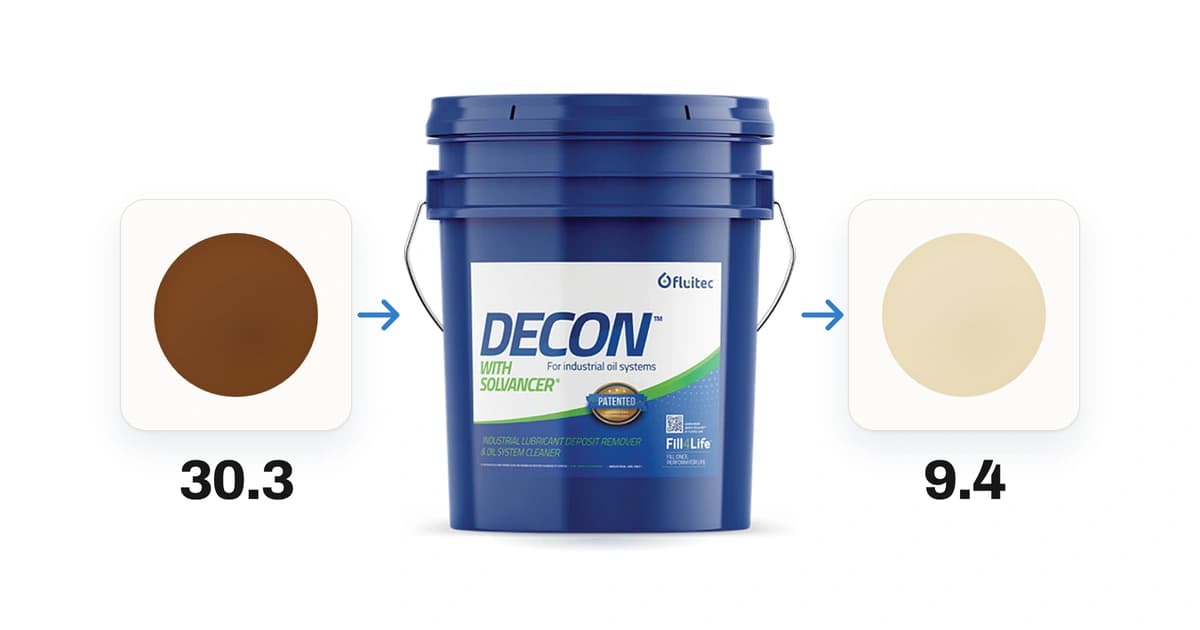
A documented Fluitec case at a major Spanish refinery began with gas-turbine MPC at 27. Antioxidant testing showed phenols at 35% and amines at 25% of their reference levels. The refinery was facing a shutdown for flushing and full oil replacement.
The refinery used Fluitec DECON™ AO at a 3% treatment rate. The case reports that MPC fell from 27 to 7 within one month. Phenolic antioxidants rose to 66% and 68% in the reported follow-up results, while aminic antioxidants rose to 100% and were maintained.
27 → 7
MPC within one month
25% → 100%
reported aminic antioxidant result
$258K
reported cost avoided
The customer remained in operation without the planned flush or oil change. The case reports no unexpected shutdowns, a varnish-free system, and $258,000 saved by avoiding the flush, oil replacement, and associated downtime.
This is one refinery's documented outcome, not a standard dose, expected saving, or promise for another plant. Oil formulation, compatibility, system condition, contamination, operating duty, equipment requirements, and the evidence collected before treatment all affect the decision.
Use this checklist before accepting "normal"
- Record the exact oil product, grade, reservoir volume, oil age, and make-up history.
- Compare results with a representative new-oil reference where the method requires one.
- Confirm the sampling point, procedure, laboratory method, and sample handling stayed consistent.
- Plot MPC and antioxidant results over time instead of reading only the latest line.
- Add bearing temperatures, valve response, filters, alarms, trips, and inspection findings to the same timeline.
- Check what each test did not measure before accepting an overall 'normal' label.
- Use oil-specific, equipment-specific, and site-specific limits. Do not copy a case-study number as a universal alarm.
- State the maintenance decision the evidence must support before choosing the next test or intervention.
Build the trend before choosing the intervention
- Verify the sample. Confirm the sampling point, oil temperature, procedure, bottle, handling, and laboratory method before explaining a sudden change.
- Use the right reference. Antioxidant results need a suitable new-oil baseline. Changes in oil brand, formulation, top-up practice, or laboratory method can break the comparison.
- Plot oil and machine data together. Put MPC, antioxidant levels, bearing temperatures, valve response, filter events, trips, and maintenance on one timeline.
- Decide what evidence is missing. The next step may be a repeat sample, a different test, inspection, filter review, or a wider oil-health assessment. Do not start with a product.
- Qualify the response. Filtration, deposit removal, antioxidant restoration, and oil replacement solve different problems. Compatibility and equipment requirements must be checked before treatment.
- Prove the machine result. A better laboratory number matters most when the bearing, valve, filter, temperature, and trip trends improve and stay stable.
NATCOM's oil analysis service can help define the test list and interpret the results in the context of the asset. Our Oil Care Technologies cover the monitoring, contamination-control, and treatment options that may follow a diagnosis.
If the machine symptoms keep returning, read our explanation of why an oil change may leave turbine varnish behind. For an operating case, see how an Egyptian fertilizer plant connected a sticky governor valve to the oil trend.
Source note
The technical basis comes from ASTM International, the three-plant study by Chokelarb and co-authors, and Fluitec's documented Spanish refinery case.
Frequently asked questions
Can routine oil analysis miss turbine varnish risk?
It can leave the question unanswered if the selected tests do not assess varnish-related insoluble material or remaining antioxidants. Viscosity, water, acid number, and particle count are useful, but each measures a different part of oil or contamination condition. The report should be read test by test and as a trend, alongside machine evidence.
What does the MPC test measure?
Membrane Patch Colorimetry, or MPC, extracts insoluble contaminants from an in-service turbine-oil sample onto a membrane and measures the patch colour with a spectrophotometer. ASTM D7843 reports the colour difference as a Delta E value and describes the result as a trending tool within a wider condition-monitoring programme.
Is an MPC result the percentage of varnish in the oil?
No. Delta E is a colour-difference value, not a percentage of varnish and not a measurement of deposit thickness on a bearing or valve. The result should be compared with the oil's history, the laboratory method, equipment guidance, inspection findings, and other oil tests.
Does RULER show the percentage of oil life remaining?
No. RULER uses linear sweep voltammetry to compare active primary antioxidants in the used oil with a suitable reference. A reported antioxidant percentage is not the same as the percentage of calendar life remaining. ASTM guidance calls for trend analysis and additional techniques before making a final oil-life decision.
Why read MPC and antioxidant results together?
They answer different questions. MPC trends insoluble coloured material associated with deposit formation. Antioxidant testing tracks part of the oil's protection against oxidation. Reading both with operating and inspection evidence helps separate a deposit symptom from the oil chemistry that may be contributing to it.
Is one turbine-oil sample enough to approve treatment or an oil change?
Usually not. One sample is a snapshot. Confirm the sampling method and use a trend where possible, then compare the oil results with machine symptoms, inspection evidence, filtration history, operating duty, oil formulation, and equipment requirements before choosing an intervention.
The word "normal" should start a question, not end the review
A laboratory report is a set of measurements, not a verdict on every condition inside the turbine. If the operating evidence and the report disagree, inspect the scope of the report before dismissing the machine symptom.
Ask what the oil was tested for, what reference was used, how the result is trending, and whether the machine agrees. That is the difference between filing a green report and making a defensible maintenance decision.